






Field Audits Temporarily Suspended by BIR: Chief Mendoza Orders Nationwide Freeze Amid Senate Calls
Disclaimer: QNE Software Philippines, Inc. published this Field Audits Temporarily Suspended by BIR blog to inform readers of the latest developments regarding BIR field audit operations. The content is for informational purposes only and should not be construed as legal or tax advice. QNE cannot be held liable for any misinterpretation, errors, or actions taken based on this information. Policies and directives from the BIR may change at any time without prior notice.
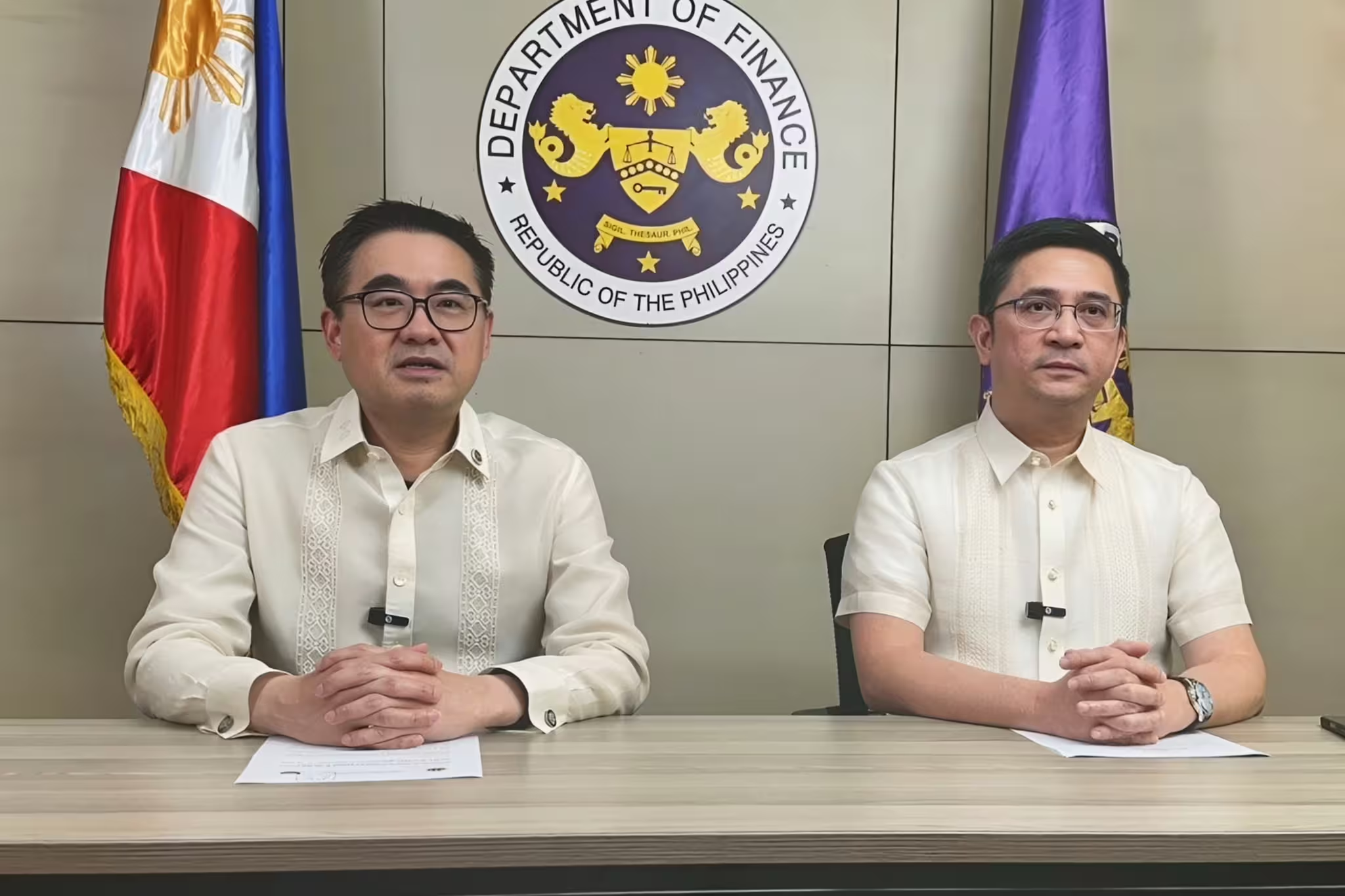
Photo from Bureau of Internal Revenue Philippines
The Bureau of Internal Revenue (BIR) has mandated the immediate and temporary suspension of all field audits and related operations across the country. This sweeping directive, issued via Revenue Memorandum Circular (RMC) No. 107-2025, comes in direct response to serious complaints from businessmen and taxpayers regarding potential misuse of authority and irregularities within the audit process.
BIR Commissioner Charlie Mendoza, who was recently sworn into office by President Ferdinand Marcos Jr., made the decisive order on Monday, November 24, 2025. The core mandate of the suspension is clear: no Letter of Authority (LOA) or Mission Order (MO) shall be created, printed, signed, or served during the suspension period.
Rationale: Protecting Taxpayers and Ensuring Integrity
The move was undertaken after extensive internal consultations and guided by the strategic oversight of Finance Secretary Frederick Go. Both officials emphasized that the decision aligns with national priorities focused on good governance, efficient revenue administration, and, crucially, taxpayer protection.
Commissioner Mendoza stressed that the suspension is necessary “to protect taxpayer rights, strengthen internal discipline, and ensure the integrity of our audit processes”. He affirmed the agency’s commitment to addressing complaints seriously, stating that “any misuse of authority, harassment, or irregularity has no place in the Bureau”.
Finance Secretary Go echoed this sentiment, confirming that the Department of Finance (DOF) is immediately acting on public concerns. “We hear the people. We hear your concerns and are immediately acting on them. The people deserve better,” Go stated. He added that the DOF is committed to protecting taxpayers from potential abuse through a comprehensive review of existing policies and procedures. Go also affirmed that the economy relies on taxpayers, who “deserve fair and honest tax audits,” emphasizing that all taxpayers must be treated “with the highest degree of professionalism, courtesy, and adherence to the rule of law”.
The Context: Senate Probe Calls and Alleged Schemes
The immediate trigger for the directive followed Senator Erwin Tulfo filing a resolution urging the Senate Blue Ribbon Committee to launch an investigation. This probe would focus on an alleged money-making scheme within the BIR concerning LOAs. Tulfo reported that at least five businessmen had approached him, expressing willingness to file formal complaints and submit supporting documentation.
Understanding the tools central to the controversy is key. The Letter of Authority (LOA) is defined as the BIR’s primary legal document that authorizes revenue officers to examine a taxpayer’s books and records. It grants the Commissioner the authority to conduct audits based on a clear legal foundation. Complementing the LOA is the Mission Order (MO), an administrative instrument used for authorizing surveillance, verification, site inspections, and other limited fact-finding activities. Unlike the LOA, an MO does not authorize audits, examination of books of account, or the issuance of assessments.
The RMC underscores the regulatory importance of these documents, noting that the Commissioner is empowered to regulate the issuance, recall, restriction, or suspension of LOAs to maintain administrative integrity. To protect the integrity of the audit operations and prevent exposure to potential abuse, the BIR determined it must conduct a comprehensive review of policies and procedures.
Scope of the Suspension: Offices and Transactions Covered
The temporary suspension is comprehensive, applying to all BIR offices that conduct field audits and related operations. These include, but are not limited to:
- Large Taxpayers Service (LTS).
- Revenue Regions (RRs) and Revenue District Offices (RDOs).
- Assessment Divisions and National and Regional Investigation Divisions.
- VAT Audit Units and Sections.
- Intelligence and Special Audit Units.
- Other offices, committees, and task forces authorized to conduct examinations or verifications of taxpayers’ records.
Specifically, the suspension covers all ongoing field audits and related field operations, including the issuance of LOAs, MOs, the examination and verification of taxpayers’ books of accounts, and other related transactions. Furthermore, the RMC dictates that no revalidation, extension, replacement, or supplementary LOA and MO shall be issued during the suspension period, unless specifically falling under the defined exceptions.
All concerned offices and task forces must submit an inventory of all pending or unserved LOAs, recalled or expired LOAs, MOs, and supplementary or related LOAs/MOs, including their status, to the Office of the Commissioner within fifteen (15) working days from the RMC’s effective date. Failure to comply with the Order constitutes an administrative offense, and erring personnel may face disciplinary action.
Exceptions
During this suspension period, the issuance of written orders to audit or investigate taxpayers’ internal revenue liabilities is suspended, except in the following circumstances:
- Investigation of cases prescribing within six (6) months from the date of this Order;
- Processing and verification of estate tax returns, donor’s tax returns, capital gains tax returns, and withholding tax returns on the sale of real properties or shares of stocks, together with the documentary stamp tax returns related thereto;
- Examination or verification of internal revenue tax liabilities of taxpayers retiring from business;
- LOAs/MOs necessary for active criminal probes conducted by duly authorized enforcement units through verified intelligence reports, inter-agency referrals, third-party data validation, or risk-scoring anomalies that require immediate audit action where delay would prejudice the government’s case;
- Claims for refund where the issuance of an LOA is statutorily required; and
- Other matters/concerns where deadlines have been imposed or under the orders of the Commissioner.
The Path to Reform: A New, Digital Future for Audits
To institutionalize lasting changes, Commissioner Mendoza has ordered the creation of a Technical Working Group (TWG) on LOA and MO Integrity and Audit Reforms. The TWG is tasked with leading the reform efforts by evaluating existing procedures and identifying both operational and systemic vulnerabilities.
The mandate of the TWG is robust, including recommending revised LOA protocols and integrating both digital safeguards and uniform audit standards. Mendoza’s ultimate goal is to create audit processes that are “predictable, evidence-based, technology-driven, and fair”. These modernized systems are designed to protect taxpayers while simultaneously helping the BIR perform its revenue mandate efficiently.
This massive reform effort directly stems from the overarching directive given by President Marcos Jr. when Mendoza assumed office: to ensure efficient and fair revenue collections. The President has directed the BIR to “continue meeting revenue targets while strengthening service delivery for workers, small business owners, and all taxpayers who rely on predictable and transparent audit processes”.
The temporary suspension of field audits signals a fundamental shift in how the BIR intends to operate, aiming to rebuild public trust and ensure that the vital function of tax collection is carried out without misuse or harassment. This pause, therefore, acts like a system-wide diagnostic check, allowing the agency to dismantle old, corrupt mechanisms and implement standardized, technology-driven protocols to ensure fairness for every contributing taxpayer.
Frequently Asked Questions
Field audits are formal examinations by the Bureau of Internal Revenue (BIR) of a taxpayer’s books, records, and transactions, authorized through Letters of Authority (LOAs) and Mission Orders (MOs).
The suspension addresses complaints of misuse of authority and irregularities, protecting taxpayers and ensuring audit integrity.
The suspension is mandated under Revenue Memorandum Circular (RMC) No. 107-2025.
LOA: Authorizes auditors to examine books and accounts.
MO: Authorizes inspections or fact-finding; does not allow audits or assessments.
All ongoing audits, LOAs, and MOs are paused unless they fall under the exceptions. Offices must submit an inventory of pending or unserved LOAs/MOs within 15 working days.