







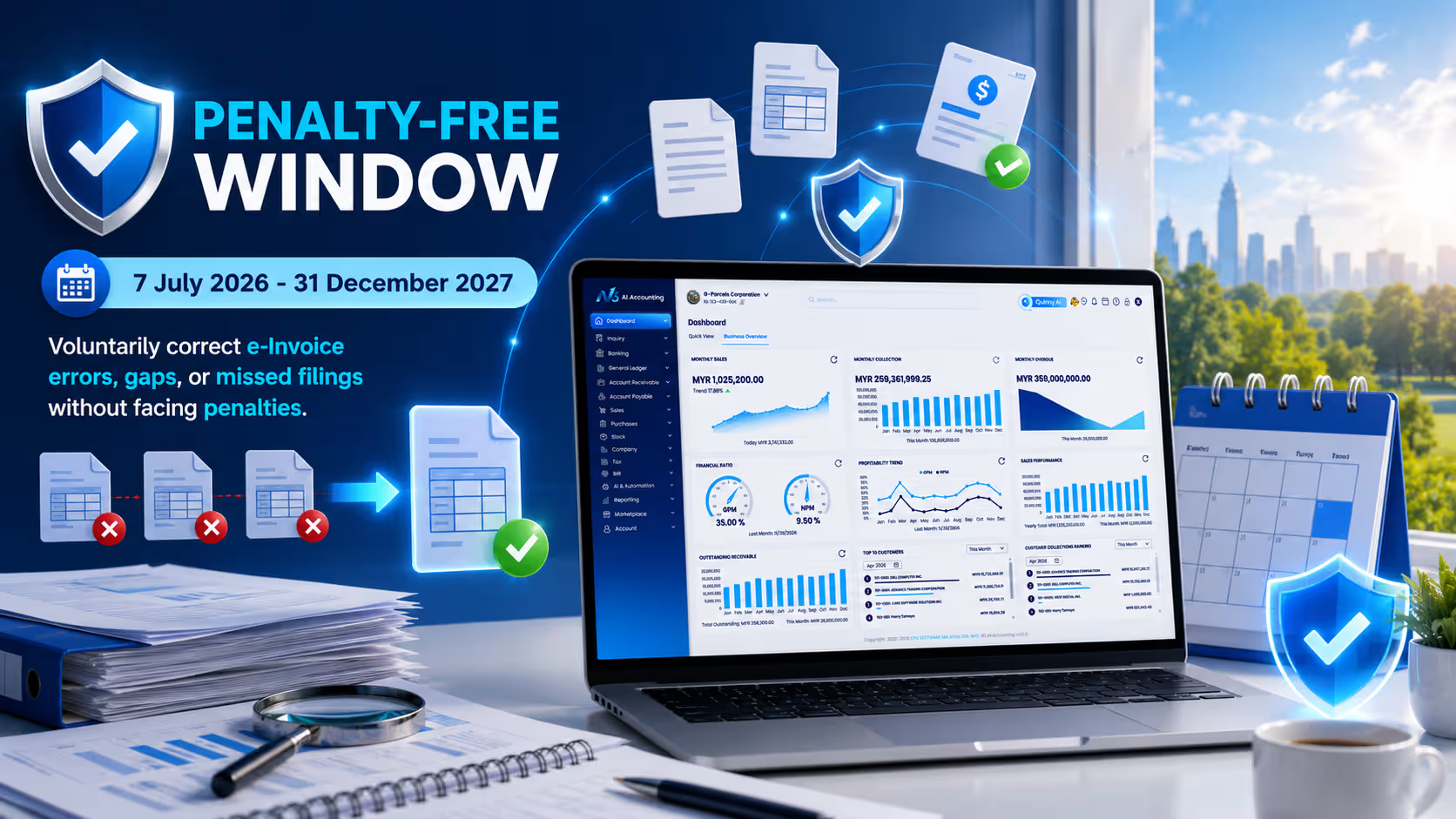
The e-Invoice Special Voluntary Disclosure Programme: Your Penalty-Free Window to Fix e-Invoice Errors Closes 31 December 2027
- Published on
If your business rushed to implement e-Invoice under the mandatory rollout, there’s a good chance something slipped through the cracks — a few missed transactions, a consolidated invoice that never got filed, a field that doesn’t quite match the spec. Until now, fixing that meant hoping IRB never noticed.
That’s changed. On 7 July 2026, the government opened an 18-month window — the e-Invoice Special Voluntary Disclosure Programme (SVDP) — where you can correct those gaps yourself, penalty-free. If you’re thorough about it, you can also pull forward a tax break on your e-Invoice-related tech spending. This is the kind of announcement that’s easy to skim past. It shouldn’t be.
What Is the e-Invoice Special Voluntary Disclosure Programme?
Prime Minister Anwar Ibrahim, in his capacity as Finance Minister, announced the new e-Invoice Special Voluntary Disclosure Programme in Parliament on 7 July 2026. The Inland Revenue Board (HASiL/LHDN) followed with an official statement the same day, and the programme is now formally written into Section 17 of the e-Invoice Specific Guideline (Version 4.8).
In short: if your e-Invoice submissions since your mandatory implementation date have gaps, errors, or missing filings, you now have until 31 December 2027 to come forward, correct them, and pay no penalty.
There’s also a secondary incentive. Businesses that get fully compliant during this window can claim full capital allowance in a single year — instead of the usual multi-year spread — on the ICT equipment and software they bought or built for e-Invoice compliance.
According to the PM, more than 50,000 taxpayers have already submitted an additional RM1 billion in taxes since the e-Invoice rollout began, and the mandatory requirement was extended to businesses earning up to RM5 million annually from 1 January 2026. This SVDP is essentially IRB’s acknowledgment that a rollout this fast created gaps — and an invitation to close them before enforcement catches up.
Why the e-Invoice Special Voluntary Disclosure Programme Matters for Business Owners?
1
Financial impact
No penalty for correcting past e-Invoice errors — but only if you act before the deadline. After 31 December 2027, you're back under normal enforcement, which can mean fines and prosecution.
2
Cash flow impact
If you invested in ICT equipment or software to get e-Invoice-ready, you may now be able to claim the entire capital allowance in one year instead of spreading it out. That's real cash back sooner — but the exact conditions (which year of assessment, qualifying costs) haven't been fully published yet, so don't assume anything until the detailed rules land.
3
Operational impact
This isn't a blanket "do nothing and you're safe" programme. You still need to submit corrections properly, using special e-Invoice versions, and consolidated invoices must go in month by month — not as one giant backlog dump.
4
Risk to know
If IRB finds problems in what you submit, or if the gap involves fraud, wilful default, or negligence, the protection doesn't apply. This is for honest catch-up, not a shield for deliberate non-compliance.
What the e-Invoice Special Voluntary Disclosure Programme Means for Accountants and Bookkeepers?
Advisory opportunity
This is a natural moment to reach out to every client who implemented e-Invoice in the last two years and offer a compliance health check. Clients won't think to ask — you need to raise it.
Workflow impact
If you manage e-Invoice submissions on behalf of clients, note that SVDP filings use different software versions (1.2/1.3) than normal submissions. Your team needs to know the distinction before filing anything under this programme.
Client conversation starter
For clients with multiple entities under one group, remind them the exposure and the fix both apply entity by entity — not at group level. That's an easy detail to miss and a valuable one to flag.
Revenue opportunity
A structured "e-Invoice SVDP Review" service — checking transaction history against submission records — is a billable, time-bound engagement you can package and offer proactively.
Key Takeaways
- The e-Invoice SVDP runs from 7 July 2026 to 31 December 2027 — mark the deadline now.
- Voluntary corrections made in good faith get zero penalties, even if you've already been notified of a compliance review.
- Fraud, wilful default, or negligence are not covered — this is for genuine gaps, not cover-ups.
- Corrections must use special e-Invoice versions (SVDP 1.2 without digital signature, SVDP 1.3 with) — not your normal submission format.
- Getting fully compliant may unlock a same-year capital allowance claim on your e-Invoice tech spend — confirm the exact mechanics before you claim.
Regulators rarely open a door this wide voluntarily. The fact that IRB is offering an 18-month, penalty-free correction window — with a cash flow sweetener attached — tells you the e-Invoice rollout created more gaps than anyone wants to admit publicly. The businesses that come out ahead won’t be the ones who wait to see what happens. They’ll be the ones who quietly audit themselves now, while “voluntary” is still an option.
Not sure if your e-Invoice submissions are fully compliant?
Don’t wait until the final review window closes. As businesses rush to review and correct their records closer to December 2027, accountants and advisors will be facing higher demand and limited availability.
Start your e-Invoice review early. Speak with your accountant or tax advisor, or let N3 AI Accounting help you get there faster. N3 AI Accounting keeps your invoicing records organized and easy to trace, so reviewing your submission history for the SVDP — instead of digging through scattered files — becomes a straightforward, guided process. With N3 AI Accounting, managing e-Invoice compliance doesn’t have to be complicated.
Talk to us today: 013-264 2498
Stay Ahead with Smarter Business Updates
Join our free community for:
- AI accounting insights
- e-Invoice updates & compliance knowledge
- Accounting best practices
- Webinars & industry sharing
- Practical strategies and tools that help your business grow
If it helps you stay ahead, it belongs in the community.

Frequently Asked Questions
What is the e-Invoice Special Voluntary Disclosure Programme?
It’s an 18-month, penalty-free window (7 July 2026 to 31 December 2027) introduced by the Inland Revenue Board (IRB) that lets Malaysian businesses voluntarily correct e-Invoice errors, gaps, or missed filings without facing penalties.
When does the e-Invoice Special Voluntary Disclosure Programme end?
The programme closes on 31 December 2027. After that date, normal enforcement resumes, which can include fines and prosecution for uncorrected errors.
Does the SVDP cover fraud or negligence?
No. The programme is for honest, good-faith corrections only. If a gap involves fraud, wilful default, or negligence, the penalty-free protection does not apply.
What software version do I use to submit corrections under the SVDP?
Corrections must be filed using special e-Invoice versions — SVDP 1.2 (without digital signature) or SVDP 1.3 (with digital signature) — not the normal submission format.
Can I still claim capital allowance on my e-Invoice tech spending?
Businesses that become fully compliant during the SVDP window may be able to claim full capital allowance in a single year on ICT equipment and software bought for e-Invoice compliance, instead of spreading it over several years. Detailed conditions have not yet been published.