


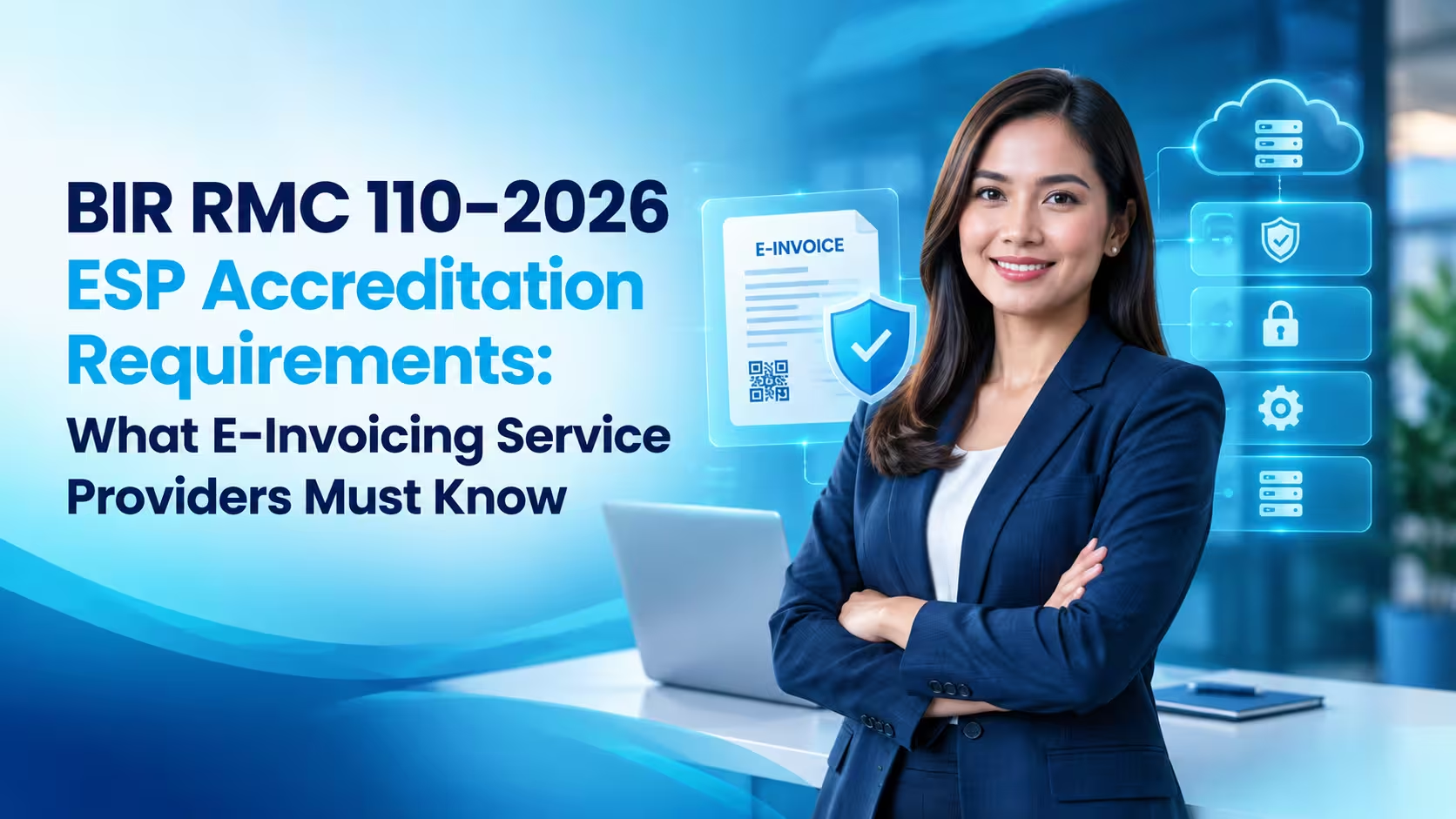
BIR RMC 110-2026 ESP Accreditation Requirements: What E-Invoicing Service Providers Must Know
- QNE Software Philippines
- Published on
What are the BIR RMC 110-2026 ESP accreditation requirements?
BIR Revenue Memorandum Circular (RMC) No. 110-2026 sets out the accreditation, technical, operational, security, data-governance, legal, and ongoing compliance requirements for Electronic Invoicing Service Providers (ESPs). Its key rule is that a covered ESP cannot commercially deploy its solution for live taxpayer transactions until the Bureau of Internal Revenue (BIR) has accredited the specific solution and issued a valid Electronic Invoicing Solutions Accreditation Certificate. Accreditation applies to the evaluated solution and configuration, not automatically to every product or deployment offered by the provider.
These requirements matter to both businesses choosing accounting or invoicing software and companies providing e-invoicing services. Businesses need to know which solutions are approved for production use, what the approval covers, and which compliance obligations remain their responsibility.
KEY REQUIREMENT
BIR Accreditation Before Live Deployment
A covered ESP must have a valid Electronic Invoicing Solutions Accreditation Certificate for the specific solution and configuration before commercial deployment for live taxpayer transactions.
Accreditation
Obtain the required BIR accreditation and certificate.
Technical & Operational
Meet applicable system and operational requirements.
Security & Data Governance
Address applicable security and data-governance obligations.
Legal & Ongoing Compliance
Meet continuing legal and regulatory obligations.
- Important: Accreditation covers the specific solution and configuration evaluated by the BIR, not automatically every product offered by the provider.
Who qualifies as an ESP Under RMC 110-2026?
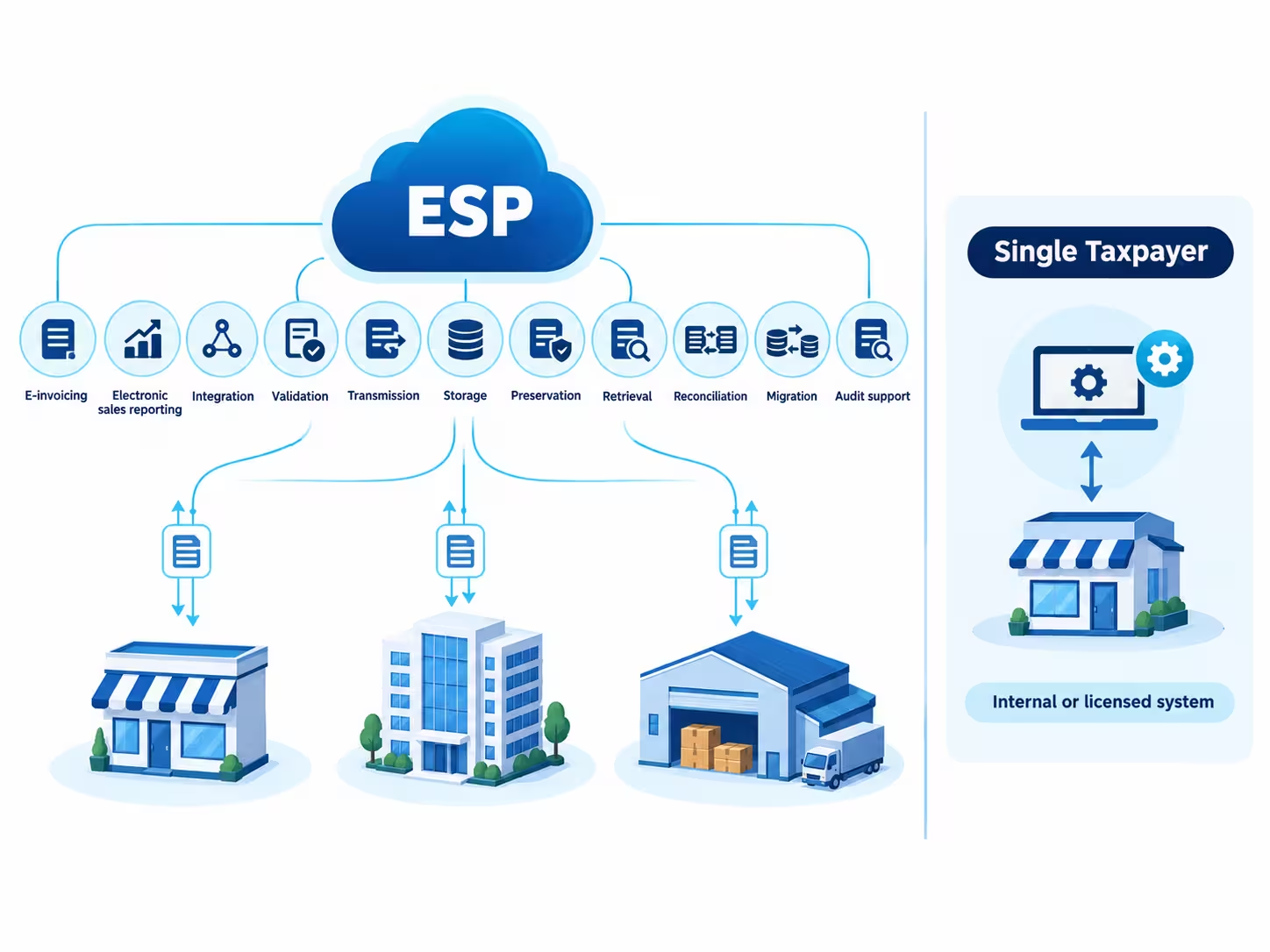
An ESP is a Philippine juridical entity that provides services such as e-invoicing, electronic sales reporting, integration, validation, transmission, storage, preservation, retrieval, reconciliation, migration, or audit support to taxpayers. RMC 110-2026 applies to e-invoicing solutions and related services offered by ESPs.
Prepare Your Business for Electronic Invoicing
Get ready for evolving BIR e-invoicing requirements with N3 E-invoicing Solution
What must an ESP demonstrate to the BIR?
Accreditation is not only a document review. The circular describes a staged process that includes documentary completeness, fit-and-proper and financial-capacity review, architecture and end-to-end data-flow review, privacy and cybersecurity assessment, system demonstration, interoperability and end-to-end transmission testing, and load, stress, failover, backup, and recovery testing. An applicant must complete the mandatory stages before the solution can be authorized for production use.
The technical and operational requirements cover reliable structured invoice data, audit trails, security controls, service continuity, data access, and portability. Taxpayer and BIR records must remain accessible and capable of retrieval, export, transfer, or migration in a complete and machine-readable format. The BIR’s checklist includes company and registration records, financial statements, service-level materials, system/version screenshots, sample documents and reports, technical specifications, hosting and data-location disclosures, security controls, incident-response planning, third-party assessment evidence, backup and disaster-recovery plans, and an exit and data-portability plan.
The circular also sets capability expectations for applicants. It requires the provider to demonstrate independently verifiable operating experience and sufficient capacity for its proposed service. Among the stated track-record criteria are systems collectively capable of processing at least five million transactions annually and supporting at least 1,000 active user or customer accounts in each of the three immediately preceding years. The specific checklist and full circular should be reviewed for the complete documentary and technical requirements.
ESP accreditation, PTI, and EIS Certification are different
PROVIDER
ESP Accreditation
Approves the specific e-invoicing solution and configuration offered by the service provider.
Taxpayer
PTI Electronic Invoice
Authorizes the taxpayer to issue electronic invoices through the applicable registered or approved system.
System testing
EIS Certification
Validates the taxpayer's system capability against applicable BIR requirements.
- Remember: One does not replace the others. ESP accreditation does not replace a taxpayer's PTI or EIS Certification. Businesses must verify the applicable requirements for their own circumstances.
ESP accreditation belongs to the provider and applies to the provider’s particular invoicing solution. A Permit to Issue (PTI) Electronic Invoice is issued to a taxpayer and authorizes that taxpayer to issue electronic invoices through a duly registered or approved system. EIS Certification is the testing process that validates the taxpayer’s system capability under the requirements referenced in RMC 98-2026. RMC 110-2026 explicitly says ESP accreditation does not replace a taxpayer’s PTI or EIS Certification.
The practical takeaway is that provider approval and customer authorization are separate checkpoints. A business should confirm the relevant solution’s production approval and also confirm what BIR permits, certifications, or registrations apply to that business, its branches, and its chosen configuration.
For a broader explanation of how these requirements differ, read our guide:
6 Questions to Ask Before Choosing an E-Invoicing Service Provider
Before relying on an e-invoicing service, ask the provider for written answers to these questions:
- Has the BIR issued a valid Electronic Invoicing Solutions Accreditation Certificate for this exact solution?
- Does the certificate cover the version, modules, interfaces, hosting environment, and production configuration being offered?
- What does the provider help the taxpayer prepare for a PTI application, and who remains the PTI holder?
- How does the system preserve invoices, audit trails, and records in a way that supports access, export, and migration?
- What happens during an outage, a security incident, or a material change to the system?
- Which services are available now, which remain in testing, and what can be used for live transactions?
Preparing for BIR E-Invoicing? Explore Your Accounting Software Options
QNE Software Philippines has published its CEO commitment to BIR e-invoicing readiness, outlining its commitment to preparing and enhancing its accounting solutions to support applicable BIR requirements.
For businesses evaluating accounting and invoicing solutions, N3 E-invoicing Solution offers accounting and invoicing capabilities to support daily financial workflows. To discuss your business requirements, contact QNE Software Philippines.
FAQs on BIR RMC 110-2026 and ESP Accreditation
Can an e-invoicing service provider issue live electronic invoices before BIR accreditation?
No. Under RMC 110-2026, covered ESPs may conduct disclosed demonstrations and controlled pre-production testing, but they cannot process live taxpayer transactions through the solution before receiving the required BIR accreditation.
Does BIR ESP accreditation automatically make a business compliant?
No. The customer must still meet applicable taxpayer-level requirements, including PTI and EIS Certification under RMC 98-2026.
Does RMC 110 cover software used only by one taxpayer?
A qualifying system used exclusively by one taxpayer and its registered branches is outside this circular’s ESP coverage, but remains subject to applicable taxpayer-level rules.
What does the BIR ESP accreditation certificate cover?
The certificate covers the specific e-invoicing solution and configuration evaluated by the BIR. Businesses should verify that the approved product version, modules, interfaces, hosting environment, and production configuration match the solution being offered.
What must an e-invoicing service provider demonstrate to obtain BIR accreditation?
An ESP must complete the applicable documentary, financial-capacity, technical, security, privacy, interoperability, and operational assessments. These include system demonstrations and testing for performance, failover, backup, and recovery, as specified in RMC 110-2026 and the applicable BIR checklist.
Where can I read the rules?
Read RMC 110-2026, its ESP checklist, and RMC 98-2026. To discuss N3 E-Invoicing Solution for your workflow, schedule a demo and confirm the current product status and your BIR requirements before issuing electronic invoices.
Prepare Your Business for Electronic Invoicing
Get ready for evolving BIR e-invoicing requirements with N3 E-invoicing Solution
Related Articles
Explore more guides to help you navigate accounting, tax compliance, and e-invoicing.
Electronic Invoicing Philippines: What Businesses Need to Know About RMC 98-2026
Learn what electronic invoicing in the Philippines means under BIR RMC No. 98-2026, including who needs to comply, key requirements,...
Read MoreMore insights for your business?