





LHDN Raises the e Invoice Exemption Threshold to RM3 Million — But Don't Assume You're Automatically Exempt
- QNE Software Malaysia
- Published on
If your business has been sitting just above the RM1 million threshold, there’s a good chance you just got some breathing room.
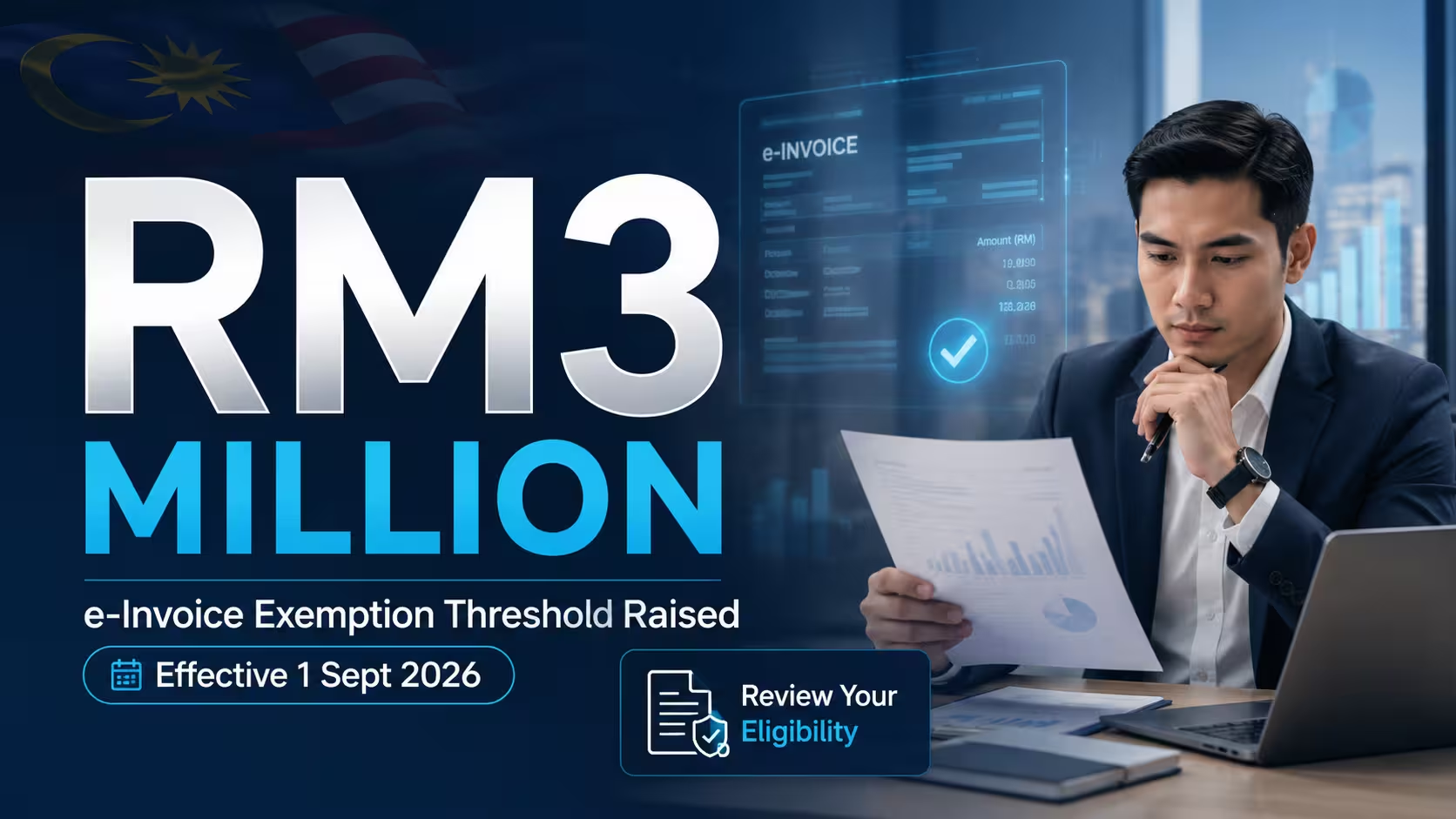
On 1 September 2026, the e invoice exemption threshold increased from RM1 million to RM3 million. For many Malaysian MSMEs, that means a significant reduction in their immediate e-Invoice compliance burden.
But there’s a catch: below RM3 million does not automatically mean you are exempt.
Your shareholders, holding company, related companies and joint ventures may affect your eligibility. And if your business is already issuing e-Invoices, you shouldn’t simply switch everything off without reviewing the latest guidance first.
How the e Invoice exemption threshold changed?
The Government and the Inland Revenue Board of Malaysia (LHDN) have raised the annual turnover or revenue threshold for mandatory e-Invoice implementation from RM1 million to RM3 million, effective 1 September 2026 — following [2026 National Day Prime Minister’s Datuk Seri Anwar Ibrahim]
The change is expected to benefit more than 1.1 million businesses, particularly micro, small and medium enterprises (MSMEs), by reducing the immediate compliance and implementation burden associated with e-Invoicing.
Under the revised position, taxpayers with annual turnover or revenue of less than RM3 million are generally exempt from issuing e-Invoices, including self-billed e-Invoices. In practice, this e Invoice exemption RM3 million update replaces the previous RM1 million threshold as the line that determines who must comply.
However, the latest guidance introduces important conditions relating to ownership and group structure. A business below RM3 million may still be required to implement e-Invoice where:
- It has a non-individual shareholder or equivalent with annual turnover or revenue of at least RM3 million;
- It is a subsidiary of a holding company with annual turnover or revenue of at least RM3 million; or
- It has a related company or joint venture with annual turnover or revenue of at least RM3 million.
So the question is no longer simply “Is my company below RM3 million?” The better question is: “Does my business actually qualify for the e invoice exemption after considering its ownership and group structure?”
Why This Matter?
For Business Owners
Financial and operational impact
For eligible businesses below RM3 million, the new threshold can remove the immediate cost and operational burden of mandatory e-Invoice implementation — including businesses previously caught between RM1 million and RM3 million, subject to the conditions below.
Group structure matters
This is the biggest point business owners need to understand about e invoice exemption eligibility. A company generating RM2 million on its own may appear to qualify — but if it has a qualifying corporate shareholder, parent company, related company or joint venture exceeding RM3 million, the exemption may not apply. Your company's own revenue is only one part of the assessment.
Growth impact
Businesses approaching RM3 million shouldn't treat the new threshold as a reason to stop preparing. If you're growing, now is still a good time to make sure your accounting system, customer and supplier data, invoicing workflow and internal processes are ready for future requirements.
For Accountants and Bookkeepers
Advisory opportunity
This announcement creates an immediate opportunity to review clients' e invoice exemption position — not just by asking for annual revenue, but by working through a fuller exemption chain:
Revenue → Shareholders → Holding Company → Related Companies → Joint Ventures
Client conversation starter
Clients earning below RM3 million may assume they're automatically exempt. This is where accountants can add value by asking the questions clients may not think to ask:
● Who are the shareholders — is there a corporate shareholder?
● Is the company a subsidiary, or does it have related companies or joint ventures?
● Has the company already started issuing e-Invoices?
For clients already issuing e-Invoices, see "What If You're Already Issuing e-Invoices" below before recommending any change to their workflow.
Revenue opportunity
This is also an opportunity to package an e Invoice Exemption Review service that assesses revenue + ownership + corporate structure + implementation status — turning a regulatory announcement into a proactive advisory offer.
Where does your business stand? (e Invoice exemption by revenue range)
Not every business falls into the same bucket. Here’s how the e invoice exemption applies depending on where your revenue sits.
Between RM3 Million and RM5 Million
The increase in the exemption threshold to RM3 million does not mean businesses in this range can postpone their e-Invoice implementation. These businesses remain within the applicable Phase 4 implementation framework: the implementation date remains 1 January 2026, and the current relaxation period continues until 31 December 2027. The SVDP also remains available within the existing programme window.
In short: RM3 million and above does not mean the e-Invoice requirement has been postponed.
Between RM1 Million and RM3 Million
This is probably the group most affected by the announcement. If your business earns between RM1 million and below RM3 million, reassess your e invoice exemption position — but don't make changes based on revenue alone. Review your ownership and group structure first. For example:
Company A — Annual revenue RM2 million, independently owned by individuals with no qualifying corporate relationships. → May qualify for the exemption, subject to the applicable conditions.
Company B — Annual revenue RM2 million, but has a qualifying corporate shareholder, parent company, related company or joint venture exceeding RM3 million. → May still be required to implement e-Invoice.
Same revenue. Different treatment, depending on group structure.
What if you're already issuing e-invoices?
A business that was previously required to implement e-Invoice because its revenue exceeded RM1 million may now fall below the new RM3 million threshold. The obvious question: “Can I just stop issuing e-Invoices?”
At this stage, don’t assume the answer is automatically yes. The general guidance contains a principle that once an implementation date has been determined, subsequent changes in a taxpayer’s own revenue do not ordinarily change their implementation obligation. But that principle was framed around changes in revenue — not specifically around a later government decision to raise the exemption threshold itself.
Businesses already issuing e-Invoices should review the latest LHDN guidance and monitor further clarification before making a permanent change to their processes. For now, caution is better than a premature switch.
New Businesses: What Changes?
The latest guidance also adjusts the treatment of newer businesses:
- Businesses or operations that commenced between 2023 and 2025: the RM3 million threshold now applies when determining implementation. A business reaching at least RM3 million in annual turnover or revenue may fall within the applicable framework.
- Businesses commencing operations in 2026 or later: the applicable date is generally 1 July 2026, or the date operations begin — whichever applies.
- Where a business commencing in 2026 or later expects its first-year turnover to remain below RM3 million, implementation is deferred until 1 January of the second year after the year its turnover first reaches RM3 million.
Being a new business does not automatically mean you’re outside the e-Invoice framework — both the commencement date and the applicable revenue threshold matter.
What has not changed?
The broader e-Invoice framework remains in place. For businesses still subject to e-Invoice, requirements around transaction reporting, submission, consolidation and record-keeping continue to apply. The relaxation period remains until 31 December 2027, with the existing enforcement framework applying from 1 January 2028. The RM3 million threshold is an exemption change — not a cancellation of the system.
Why is LHDN still encouraging voluntary adoption?
LHDN is not discouraging exempted businesses from adopting e-Invoice voluntarily — the Government continues to encourage MSME participation as part of Malaysia’s broader business digitalisation agenda, with continued support through the MyInvois Portal, MyInvois app and MyInvois e-POS. For some businesses, voluntary adoption still makes sense: more structured invoicing, better record-keeping, and greater digitalisation of accounting processes. Qualifying for the e invoice exemption doesn’t mean “don’t adopt e-Invoice” — it means the business may no longer be mandated to, subject to the applicable conditions.
Malaysia's e-Invoice adoption continues to grow
Since implementation began on 1 August 2024, LHDN reports that 265,379 taxpayers have submitted more than 1.84 billion e-Invoices. For smaller businesses, the new threshold may provide relief; for businesses above RM3 million, e-Invoice remains part of the operating environment.
What should your business do now?
Below RM3 million and not yet implemented:
Review revenue, shareholders, holding company, related companies and joint ventures. If none of the exclusion conditions apply, you may qualify for the e invoice exemption — keep documentation to support your position.
RM1 million to below RM3 million and already issuing e-Invoices:
Don't stop immediately. Review the latest LHDN guidance and monitor further clarification first.
RM3 million to RM5 million:
Continue your existing implementation and compliance processes — your obligations remain unchanged.
Approaching RM3 million:
Keep your accounting systems, invoicing workflows and supplier/customer data in good shape — being prepared early makes the eventual transition easier.
Key Takeaways
- The e invoice exemption threshold rose from RM1 million to RM3 million, effective 1 September 2026.
- Below RM3 million does not automatically mean exempt — shareholders, holding companies, related companies and joint ventures can all affect eligibility.
- Businesses between RM3 million and RM5 million remain within the applicable framework; the threshold increase does not postpone their obligation.
- Businesses already issuing e-Invoices should not immediately switch off their processes — further clarification is still developing.
- New businesses still need to assess when their obligation begins; being newly established isn’t automatic exemption.
- Voluntary adoption is still encouraged, even for businesses that qualify for the e invoice exemption.
Regulatory relief can create its own confusion. The headline is simple — RM1 million → RM3 million. The real question is: “Does my business actually qualify for the e invoice exemption?”
For many MSMEs, this will be genuine relief. For businesses with complex ownership or group structures — and for those already issuing e-Invoices — the smartest move is to review first, understand your position, then act.
Stay ahead with Smarter Business Updates
Join our free community for AI accounting insights, e-Invoice updates & compliance knowledge, accounting best practices, webinars and industry sharing, and practical strategies and tools to help your business grow.
Disclaimer: This article is intended for general informational purposes only and should not be regarded as tax, legal or professional advice. e-Invoice requirements are subject to updates and clarification by LHDN. Businesses should refer to the latest official LHDN guidance and obtain professional advice where appropriate.

Frequently Asked Questions (FAQs)
Do I need to notify LHDN to claim the e invoice exemption?
There’s no separate application — the exemption applies based on meeting the criteria (revenue below RM3 million, and no disqualifying shareholder, holding company, related-company or joint-venture relationship). Keep documentation on hand in case LHDN requests it.
I'm between RM1 million and RM3 million and already issuing e-Invoices, can I stop now?
Not immediately. Review the latest LHDN guidance and monitor further clarification before making a permanent change.
Does the e invoice exemption apply to new businesses too?
Yes, but the rules depend on your commencement year, see “New Businesses: What Changes?” above, including the deferral rule for businesses starting in 2026 or later.
What if my business is between RM3 million and RM5 million?
You remain within the applicable Phase 4 framework — the e-Invoice exemption RM3 million increase doesn’t postpone your implementation obligation.
Should I still adopt e-Invoice if I qualify for the exemption?
You can. Voluntary adoption is encouraged and can still support better record-keeping and digitalisation, even though it’s no longer mandatory for you.
Get Help Reviewing Your e Invoice Exemption Status
Not sure whether your business qualifies for the new e-Invoice exemption RM3 million update? Don't decide based on revenue alone — review your business structure, ownership and current e-Invoice status before making any changes.