









Beyond the Offer Letter: The HR Compliance Checklist Malaysian Employers Actually Need
- QNE Software Malaysia
- Published on
Take a moment and picture it: you’ve just found the right person, sent the offer letter, and they’ve said yes. There’s real relief in that — the search is over, the seat is filled, you can breathe again.
Except… that’s not actually the finish line. It’s the starting line.
The moment your new hire signs on, a whole second checklist quietly kicks in — one most first-time and even seasoned employers only discover the hard way. Registrations, forms, monthly deadlines, annual filings, and eventually, an offboarding process too. None of it is optional, and very little of it is intuitive.
If that feels like a lot, you’re not wrong — and you’re definitely not alone. This HR compliance checklist walks through the entire employee lifecycle with you, one manageable step at a time, so nothing quietly slips through the cracks.
The Flow: What This HR Compliance Checklist Actually Covers
Before we get into the details, here’s the shape of the whole journey this HR compliance checklist follows — from the day someone signs, to the day (hopefully much later) they move on:
- Onboarding — contracts, registrations, and tax forms in the first days and weeks
- Every month — statutory deductions and contributions, on repeat, for as long as they’re employed
- Every year — annual tax statements and filings
- Offboarding — the final, equally important steps when someone leaves
Let’s walk through each stage together.
Stage 1 — Mandatory Procedures After Onboarding a New Employee
This is where the HR compliance checklist really begins: the things that need your attention in the first days and weeks after someone joins. Getting these right early saves you from having to untangle payroll errors months down the line.
ONBOARDING
1. Employment Contract
Every new hire should receive a written employment contract before or on their first day — covering salary, benefits, working hours, and probation terms. It protects both of you, and it's the foundation every other form and registration builds on.
All executed employment agreements require official stamp duty payment by the employer.
Standard Stamp Fee: RM10 per contract, borne fully by the employer.
Exemption effective 1 January 2026: Employees with a monthly salary of RM3,000 or below qualify for a stamp duty waiver.
Where:
MyTax Portal > ezHasil Services > e-Duti Setem
Deadline:
- Contract signed within Malaysia: Affix the stamp within 30 days of signing.
- Contract signed overseas: Affix the stamp within 30 days after receiving the signed agreement copy.
ONBOARDING
2. Apply for an Employer Tax File ("E" Number)
If this is your very first hire, your business itself needs a tax reference number with LHDN before you can report anyone's income correctly. Most growing companies only do this once — but it has to happen before your first payroll run.
Core Usage of E Number:
- Monthly PCB/MTD tax submission
- Reporting employee tax particulars to IRB (LHDN)
- All corporate income tax formalities
Where: MyTax Portal (e-Daftar) or your nearest LHDN branch.
Deadline: Before your first payroll cycle for a first-time employer.
ONBOARDING
3. Register with EPF (KWSP)
Both you and your new employee need to be contributing to EPF from day one. If this is your first employee ever, the registration deadline is strict — so this one shouldn't wait.
Where: EPF i-Akaun (Majikan) portal or nearest KWSP branch.
Deadline: Within 7 days of hiring your first employee; ongoing for every hire after
ONBOARDING
4. Register with SOCSO & EIS
SOCSO protects your employee in case of workplace injury or invalidity, and EIS gives them a safety net if they're ever retrenched. Both are registered together, and both matter more than most employers realise until they're needed.
Where: PERKESO ASSIST Portal.
Deadline: Within 30 days of hiring your first employee.
ONBOARDING
5. Submit Form CP22 (New Employee Notification)
LHDN needs to know a new, potentially tax-chargeable employee has joined your company. It's a short notification, but an easy one to forget in the busyness of onboarding
Important:
- Effective 1 September 2024, only online e-CP22 submissions via MyTax are accepted (manual forms are no longer accepted).
- Applicable to:
- Tax-resident employees
- Individuals with prospective taxable employment income
Where: MyTax Portal (e-CP22).
Deadline: Within 30 days of the employee’s start date.
ONBOARDING
6. Collect Form TP1 (Personal Relief Declaration)
This one isn't filled in by you — it's completed by your employee, to declare personal tax reliefs (like dependents or insurance) that affect how much monthly tax should be deducted from their salary. Ask new hires to complete it during onboarding so payroll starts off accurate.
Where: Collected internally and kept on file; used to calculate monthly PCB/MTD.
Deadline: Ideally before the first payroll run; updated whenever the employee’s reliefs change.
ONBOARDING
7. Collect Form TP3 (Previous Employment Income Disclosure)
If your new hire worked elsewhere earlier this same year, this form tells you what they already earned and how much tax was already deducted — so their tax isn't calculated as if they're starting from zero. It's a small form that prevents a big miscalculation later.
Where: Collected internally and kept on file; produced to LHDN on request.
Deadline: Best collected during onboarding, before the first payroll run.
Stage 2 — Monthly Mandatory Tasks
Once onboarding is done, this HR compliance checklist shifts from a one-time set of tasks into a rhythm. These tasks repeat every month for as long as the employee is with you — which is exactly why they’re worth building into a routine rather than remembering from scratch each time.
EVERY MONTH
PCB / MTD Deduction
The monthly tax deduction taken from your employee's salary and remitted to LHDN — calculated using their salary, EPF contributions, and whatever reliefs they've declared on Form TP1.
Where: e-PCB / e-Data PCB via the MyTax Portal.
Deadline: By the 15th of the following month.
Non-Compliance Risk: Missing the monthly PCB/MTD submission deadline can lead to penalties, surcharges, and potential enforcement action by LHDN. Staying on schedule helps your business remain compliant and avoid unnecessary costs.
EVERY MONTH (IF APPLICABLE)
Form CP38 Deduction
If LHDN issues a CP38 directive for a specific employee (usually to recover tax arrears), you're required to make the additional deduction exactly as instructed, on top of regular PCB.
Where: As instructed in the CP38 notice from LHDN.
Deadline: For the duration and amount specified in the notice.
Non-Compliance Risk: Failure to comply with a CP38 directive may result in fines, penalties, and potential legal liabilities for employers.
EVERY MONTH
EPF Contribution
Both employer and employee shares are calculated and paid together — this is the contribution that builds your employee's long-term retirement savings.
Where: EPF i-Akaun (Majikan) or approved payment channels.
Deadline: By the 15th of the following month.
Non-compliance Risk: Failure to comply will result in fines, penalties and potential legal liabilities for employers.
EVERY MONTH
SOCSO & EIS Contribution
Submitted together, covering both the injury/invalidity protection and the employment insurance safety net.
Where: PERKESO ASSIST Portal
Deadline: By the 15th of the following month.
Non-compliance Risk: Failure to comply will result in fines, penalties and potential legal liabilities for employers.
Stage 3 — Annual Mandatory Tasks
Once a year, this part of the HR compliance checklist comes together into a set of formal filings. These tend to cluster in the first quarter — right when HR teams are also closing out the previous year — so a little early preparation goes a long way.
ONCE A YEAR
Form EA Issuance
A clear annual statement of everything your employee earned and had deducted over the past year. They'll need it to file their own personal taxes, so timeliness matters to them as much as to you.
Where: Issued directly to each employee.
Deadline: By the end of February each year.
Non-compliance Risk: Failure to comply will result in fines, penalties and potential legal liabilities for employers.
ONCE A YEAR
Form E Employer Annual Return
Every employer is required to submit Form E each year to LHDN, reporting the company's employee records and remuneration details for the previous year. This annual return helps ensure your payroll and tax reporting remain compliant with Malaysian tax regulations.
Where: Submit electronically via the MyTax Portal (Form e-E).
Deadline: Form E must be filed on or before 31 March each year. If LHDN officially announces an extension or grace period, the filing deadline may be extended accordingly.
Non-compliance Risk: Failure to comply will result in fines, penalties and potential legal liabilities for employers.
ONCE A YEAR
CP8D Submission
Form CP8D contains the detailed annual payroll information for your employees, including salary payments and monthly PCB deductions. It must be submitted electronically to LHDN as a separate filing from Form E.
Where: MyTax Portal > ezHasil Services > e-Data Praisi / e-CP8D
Deadline: Submit the CP8D electronically on or before 31 March each year. If LHDN officially announces an extension or grace period, the filing deadline may be extended accordingly.
Non-compliance Risk: Failure to comply will result in fines, penalties and potential legal liabilities for employers.
Stage 4 — When Someone Leaves: The Offboarding Checklist
Here’s the part that’s easy to overlook in the relief (or awkwardness) of someone leaving: a proper HR compliance checklist doesn’t stop at offboarding, and this stage is just as strict as onboarding.
OFFBOARDING
Form CP22A (Cessation of Employment)
Required whenever an employee resigns, retires, or their employment otherwise ends. You'll generally need to withhold final payments until LHDN confirms there's no outstanding tax to settle.
Where: MyTax Portal (e-SPC).
Deadline: At least 30 days before the employee’s last day.
Non-compliance Risk: Failure to comply will result in fines, penalties and potential legal liabilities for employers.
OFFBOARDING (IF APPLICABLE)
Form CP21 (Employee Leaving Malaysia)
If the departing employee is leaving Malaysia for more than 3 months — for example, relocating for a new role abroad — this form applies instead of, or alongside, CP22A.
Where: MyTax Portal (e-SPC).
Deadline: At least 30 days before the employee’s departure date.
Non-compliance Risk: Failure to comply will result in fines, penalties and potential legal liabilities for employers.
Beyond the tax forms, don’t forget the practical side of offboarding: final salary and unused leave encashment, last EPF/SOCSO/EIS contributions, a proper exit interview, and revoking system access. It’s the quieter half of the checklist, but just as important for a clean, dispute-free exit.
Summary: What This HR Compliance Checklist Really Comes Down To
Zoom out from all the individual forms and deadlines, and the whole HR compliance checklist really comes down to a handful of ideas worth remembering:
- Hiring is the easy, exciting part. Managing compliance is where the real responsibility lives.
- Onboarding has its own set of registrations and forms — and most of them are time-sensitive.
- Monthly tasks repeat like clockwork: EPF, SOCSO, EIS, and PCB, every 15th.
- Annual filings (EA, Form E, CP8D) cluster around Q1 — plan ahead.
- Offboarding is not the finish line either — CP22A and CP21 still apply.
- Missing any one step rarely causes chaos on its own. It’s usually the accumulation of small missed steps that turns into a real problem.
None of this is meant to overwhelm you — it’s meant to make sure nothing catches you by surprise. Every employer who has been through this will tell you the same thing: it gets easier once it’s a system, not a scramble.
Where QNE Cloud Payroll Fits Into All of This?
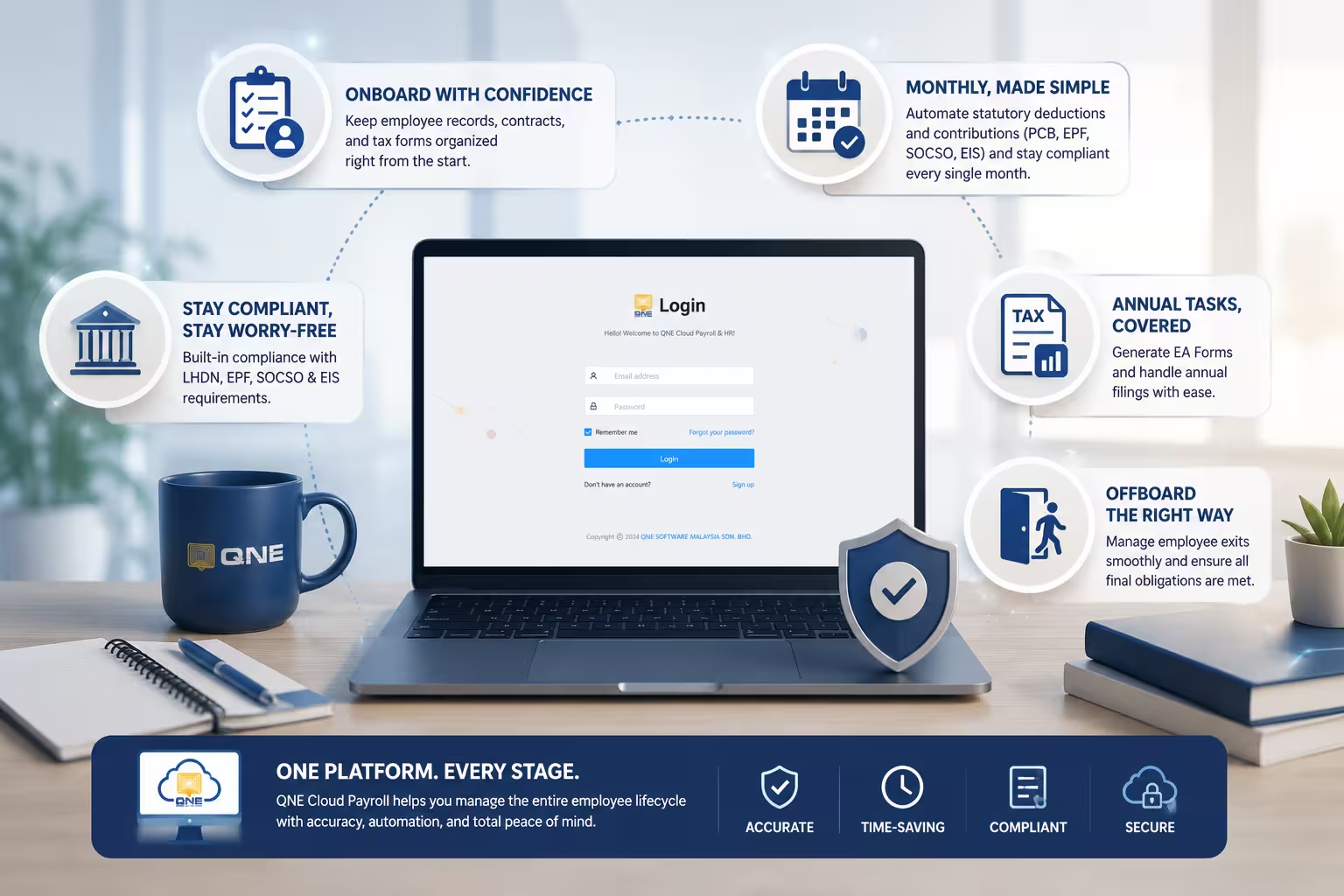
Reading this whole HR compliance checklist in one sitting is exactly why it can feel heavy. In practice, it’s spread out across a whole year — a few tasks at onboarding, a rhythm every month, a couple of filings once a year, and a short checklist whenever someone leaves. Spread out like that, it’s manageable. The real risk is trying to hold all of it in your head, or across five different spreadsheets, at once.
QNE Cloud Payroll was built around this exact lifecycle — not as an afterthought, but as the core of what it does. Instead of tracking EPF, SOCSO, EIS, PCB, and every LHDN form separately, here’s what it quietly takes off your plate at each stage:
- Onboarding: new hires are set up with the correct EPF, SOCSO, EIS, and PCB categories from day one, so nothing from that first-30-days list gets missed.
- Every month: EPF, SOCSO, EIS, and PCB are calculated automatically, with the 15th-of-the-month deadline flagged before it sneaks up on you.
- Every year: your EA Form and Form E / CP8D data are generated directly from existing payroll records, instead of being rebuilt from scratch each February and March.
- Offboarding: final pay, leave encashment, and last contributions stay accurate and ready, so a resignation doesn’t turn into a scramble.
In short: this HR compliance checklist doesn’t have to live in your head, or across five different spreadsheets. It can just run — quietly, in the background, the way compliance should.
If any part of this HR compliance checklist felt like more than your current process can comfortably keep up with, that’s usually the clearest sign it’s worth a proper look at QNE Cloud Payroll.
Frequently Asked Questions (FAQs)
What's the very first thing I need to do after hiring my first employee in Malaysia?
Get their employment contract signed, then register your company for an employer tax file (“E” number) with LHDN before your first payroll run. From there, EPF registration follows within 7 days, and SOCSO/EIS and Form CP22 follow within 30 days.
Do I need to register for EPF and SOCSO if I only have one employee?
Yes. EPF and SOCSO registration are mandatory from your very first hire, regardless of company size — there’s no employee-count threshold that exempts small employers.
Who fills in Form TP1 and TP3 — me or the employee?
The employee. TP1 declares their personal tax reliefs, and TP3 discloses any income earned earlier in the same year with a previous employer. As the employer, you simply collect, file, and use these forms to calculate accurate monthly tax deductions — you don’t submit them anywhere yourself.
What happens if I miss the 15th-of-the-month deadline for EPF, SOCSO, or PCB?
Late submissions typically result in financial penalties and late payment surcharges, and repeated lapses can escalate into further statutory or legal consequences. There’s no grace period built in, which is why most companies treat the 15th as a hard internal cutoff.
What's the difference between CP22A and CP21?
CP22A applies to any employee who resigns, retires, or otherwise stops working for you. CP21 applies specifically when an employee is leaving Malaysia for more than three months — for example, emigrating for a new role abroad. Some resignations only need CP22A; others need CP21 as well.
When exactly do I need to issue Form EA and file Form E?
Issue Form EA to each employee by the end of February every year. Then, submit Form E electronically via the MyTax Portal by 31 March. Form CP8D is a separate electronic submission and should also be filed by 31 March, unless LHDN officially announces an extension or grace period.